赌神
China, Russia launch fourth joint Arctic scientific expedition, process lasts about 62 days: report_我的网站

A |
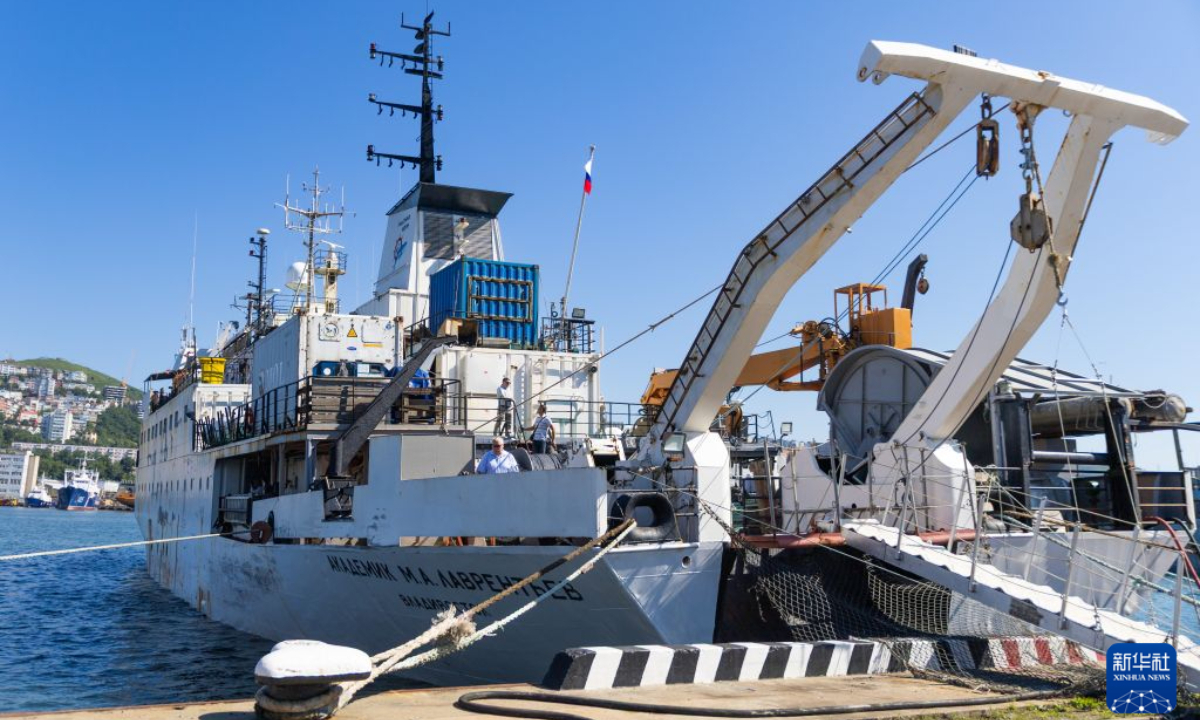
A Russian scientific expedition vessel docks at the port in Russia’s Far Eastern city of Vladivostok. Photo: Xinhua
The fourth China-Russia joint Arctic expedition was launched on Thursday in Russia’s Far Eastern city of Vladivostok. Scientists from both countries will conduct major frontier basic research on the rapid climate changes in the Arctic region, focusing on the area from the Northwest Pacific to the Arctic Ocean, Xinhua News Agency reported on Thursday. Nine people from China will participate in the voyage.
At the launch ceremony, Wei Zexun, director of the First Institute of Oceanography, Ministry of Natural Resources (MNR), said the joint expedition will focus on the waters of the Northwest Pacific and the Arctic Ocean, further deepening scientific understanding of ocean dynamic processes, climate change patterns, and marine ecosystems in the study areas. It is not only a concrete measure to implement the cooperation consensus between China and Russia in the marine field, but also a vivid example of the two countries’ comprehensive strategic partnership of coordination in marine science and technology in the new era.
According to Du Libin, executive dean of the College of Ocean Science and Engineering, Shandong University of Science and Technology, the Arctic is highly sensitive to global climate change, and a frontier for ocean science, playing a key role in the “Polar Silk Road” initiative and China-Russia polar marine cooperation.
The joint expedition will highlight deeper marine research cooperation and innovation, while advancing polar scientific exploration and practical collaboration between the two countries, Du said.
According to Zou Jianjun, chief Chinese scientist of the scientific expedition team and a researcher at the First Institute of Oceanography, MNR, the expedition will last about 62 days. The scientists will conduct multidisciplinary surveys in the Chukchi Sea, East Siberian Sea, Lomonosov Ridge, Makarov Basin, and Amundsen Basin to study changes in the marine environment of these regions amid rapid climate change and reveal their response processes and feedback mechanisms in relation to global climate change.
A representative from the Pacific Oceanological Institute (POI), Far Eastern Branch of the Russian Academy of Sciences, said during the ceremony that the joint expedition is expected to strengthen Russia-China ties and expand cooperation in the Arctic and Pacific regions.
As freight volumes along the Arctic shipping route are steadily increasing, and the role of Arctic shipping route in the global economy is becoming increasingly important, comprehensive scientific research of the region has become necessary.
Global Times
。
CAPE TOWN, South Africa -- Angry protesters in Cape Town confronted the king and queen of the Netherlands on Friday as they visited a museum that traces part of their country’s 150-year involvement in slavery in South Africa.King Willem-Alexander and Queen Maxima were leaving the Slave Lodge building in central Cape Town when a small group of protesters representing South Africa's First Nations groups -- the earliest inhabitants of the region around Cape Town -- surrounded the royal couple and shouted slogans about Dutch colonizers stealing land from their ancestors.The king and queen were put into a car by security personnel and quickly driven away as some of the protesters, who were wearing traditional animal-skin dress, jostled with police.The Dutch colonized the southwestern part of South Africa in 1652 through the Dutch East India trading company. They controlled the Dutch Cape Colony for more than 150 years before British occupation. Modern-day South Africa still reflects that complicated Dutch history, most notably in the Afrikaans language, which is derived from Dutch and is widely spoken as an official language of the country, including by First Nations descendants.King Willem-Alexander and Queen Maxima made no speeches during their visit to the Slave Lodge but spent time walking through rooms where slaves were kept under Dutch colonial rule. The Slave Lodge was built in 1679, making it one of the oldest buildings in Cape Town. It was used to keep slaves -- men, women and children -- until 1811. Slavery in South Africa was abolished by the English colonizers in 1834.Garth Erasmus, a First Nations representative who accompanied the king and queen on their walk through the Slave Lodge, said their visit should serve to “exorcise some ghosts.”The Dutch East India Company established Cape Town as a settlement for trading ships to pick up supplies on their way to and from Asia. Slaves were brought to work at the colony from Asian and other African countries, but First Nations inhabitants of South Africa were also enslaved and forced off their land. Historians estimate there were nearly 40,000 slaves in the Cape Colony when slavery ended.First Nations groups have often lobbied the South African government to recognize their historic oppression. They say their story has largely been forgotten in South Africa, which instead is often defined by the apartheid era of brutal forced racial segregation that was in place between 1948 and 1994.First Nations people have a different ethnic background from South Africa's Black majority.___AP Africa news: https://apnews.com/hub/africa。
Current article:http://niujingkongkengjuezan.buzz/ykyr/lmxa.html
Published on:16:11:55
 微信
微信 移动端
移动端


